
What is reverberation time?
Suppose a loudspeaker is switched on in a room, producing broadband noise. If you then switch off the loudspeaker, the sound will take some time to decay. For most rooms without significant echoes, the level will decay linearly with time until it’s no longer audible or blends into the ambient noise of the space. Reverberation time, commonly referred to as RT60, is the time it takes for sound levels to decrease by 60 decibels (dB), essentially making it inaudible.
What is reverberation time used for?
Reverberation time is a key parameter used to evaluate and design the acoustic performance of a room. It depends on both the absorptive properties of surfaces and the distances between them. Measuring reverberation time provides an objective, quantitative way to assess the acoustic quality of a space.
Depending on the results to be reported, the measurement of reverberation times is also a requirement of building acoustics standards for evaluating sound insulating properties of building elements such as ASTM E336 Standard Test Method for Measurement of Airborne Sound Attenuation between Rooms in Buildings, as well as the ASTM E1007 Standard Test Method for Field Measurement of Tapping Machine Impact Sound Transmission Through Floor-Ceiling Assemblies and Associated Support Structures.
In an untreated or empty room, sound reflects repeatedly off walls, ceilings, and floors. These reflections accumulate, creating what is known as reverberation. This effect can become problematic in large spaces with hard, reflective surfaces, where excessive buildup of sound reduces clarity.
For optimal acoustic design, the reverberation time must suit the intended use of the room. If it is too long, speech becomes difficult to understand and music loses clarity, sounding blurred or muddy. If it is too short, the space can feel acoustically “dead,” making sound seem flat and unnatural.
By carefully selecting materials with appropriate absorption characteristics, designers can control reverberation and achieve suitable acoustic conditions. Different applications require different balances between direct and reflected sound: longer reverberation increases background noise and reduces speech intelligibility, while shorter reverberation lowers noise levels but can make voices sound dull or muffled.
Decay Rate
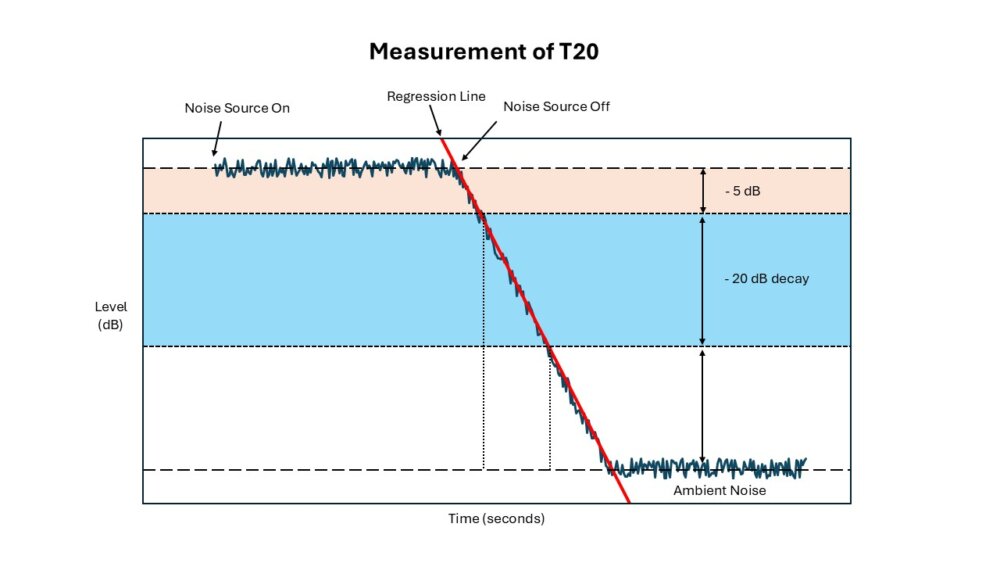
In reverberation time calculations, the rate at which sound diminishes is known as the decay rate. As noted, reverberation time is the time it takes for sound pressure levels to decrease, or decay, by 60 dB. In practice, background noise interferes with measuring the full 60 dB range. As a result, when calculating reverberation times using modern instrumentation—such as Norsonic’s Nor140, Nor145, and Nor150 sound analyzers—the decay rate is not measured across the entire 60 dB range. Instead, it is measured over a 20 dB or 30 dB window and extrapolated to obtain the 60 dB range value. The decay rate is typically measured starting from a point 5 dB below the level at the moment the sound source is switched off. Therefore, decay rates are measured between -5 dB and -25 dB relative to the level before the noise was switched off to estimate the full 60 dB decay. A least-square-fit regression method is used for fitting a linear decay which is used for the reverberation time calculation. Levels between -5 dB and -25 dB relative to the level before the noise was switched off are used for calculating the parameter T20. In a similar way, levels between -5 dB and -35 dB are used for the calculation of T30. The Nor140, Nor145 and Nor150 sound analyzers can measure T10, T20, T30, as well as EDT (Early Decay Time).
Two methods of measuring decay rates are commonly described in relevant measurement standards: the interrupted noise method and the integrated impulse response method. The integrated impulse response method is often called the Schroeder method after Dr. Manfred Schroeder who disclosed the theoretical relations between this and the interrupted noise method. The reverberation time is extracted from the decay by the use of a least mean square fit algorithm.
A third method of reverberation time measurements is also available. This measurement option enables a swept sine excitation signal.
Noise Excitation Signals
Interrupted Noise Method
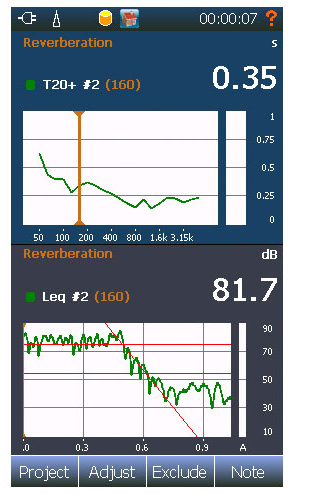 Measuring the reverberation time by using interrupted noise is often referred to as the classical method. The noise source is switched on for a time sufficient to obtain a steady level. The source is thereafter switched off, and the decay of the sound in the room is measured.
When using the interrupted noise method, a steady white or pink noise signal is fed through an appropriate power amplifier and loudspeaker within the room where the measurements are conducted. The Nor140, Nor145, and Nor150 analyzers include built-in signal generators that can be used for this purpose, as they provide a signal that can be sent to a chosen power amplifier and loudspeaker. Alternatively, Norsonic’s Nor280 power amplifier is a suitable companion, as it includes the built-in test signals. For a more portable option, the Nor282 battery-operated amplifier is a great choice. The signal from both amplifiers can be activated via remote control, and they are designed for use with the Nor283 omnidirectional dodecahedron speaker, which can generate sound levels high enough to excite all the room’s reverberation modes.
Impulse Excitation Method
Excitation for the integrated impulse response method can be any impulsive, broadband source with sufficiently low directivity. Traditionally, this has been achieved using sources such as a starter pistol, a bursting paper bag, or an exploding balloon, all of which can generate adequate sound energy across the required frequency range. More recently, tools as such as the Nor286 origami impulse source have been introduced as practical alternatives.
One advantage of impulse excitation is that it eliminates the need to transport heavy loudspeaker and amplifier systems. However, when using noise excitation with a loudspeaker, it is easier to verify appropriate signal levels and ensure consistent directional characteristics of the source.
Swept Sine Excitation
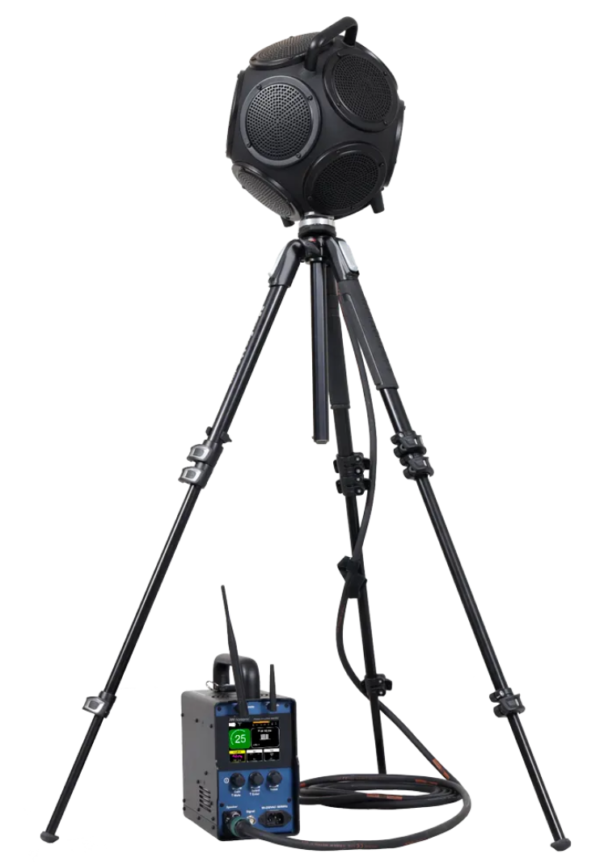 The swept-sine excitation method uses an exponential sine sweep played through a loudspeaker, and the room’s response is recorded. The sweep starts in the low-frequency range and gradually progresses to higher frequencies. Through a series of advanced calculations, the reverberation time and sound level are determined. This method offers a very high signal-to-noise ratio, making it well-suited for environments with elevated ambient noise. Norsonic’s Nor140, Nor145, and Nor150 analyzers support reverberation time measurements using this type of excitation when used in conjunction with Norsonic’s Nor850 building acoustics software. The signal can be amplified and produced using the Nor280 or Nor282 amplifier together with the Nor283 omnidirectional dodecahedron speaker.
Reverberation Time Measurement Standards
Common standards used to define the requirements for reverberation measurements include:
- ISO 3382 Acoustics — Measurement of room acoustic parameters Part 1: Performance Spaces and Part 2: Reverberation time in ordinary rooms
- ASTM E2235 –Standard Test Method for Determination of Decay Rates for Use in Sound Insulation Test Methods
Common measurement parameters specified in Parts 1 and 2 of the ISO 3382 standard include T20 and T30 reverberation metrics, as well as additional parameters such as Early Decay Time (EDT), Clarity (C50, C80), Definition (D50), and Strength (G).
Although the ASTM E2235 standard does not explicitly specify which reverberation parameter should be measured (T10, T20, or T30), the standard specifies that the first point used in the analysis should be measurement as soon as possible after the sound source is switched off, with its level no more than 5 dB below the steady-state level. The standard also states that the final point used to determine the decay rate should lie between 15 dB and 25 dB below the level of the first analysis point, and it must remain at least 10 dB above the background noise level. Consequently, as shown in the Measurement of T20 graph above, measuring the reverberation time using T20 satisfies this requirement, and therefore any instrumentation capable of measuring T20 meets the standard’s criteria.
Several ASTM standards, such as ASTM E336 and E1007 standards for field of field sound insulation of building assemblies, along with the respective E90 and E492 standards for laboratory sound insulation measurement, require the measurement of room sound absorption as part of the procedure. All these standards reference the ASTM E2235 standard for the measurement of reverberation times and calculation of the sound absorption of rooms.
Per the standard, the absorption of the room and its contents is calculated from the Sabine formula:
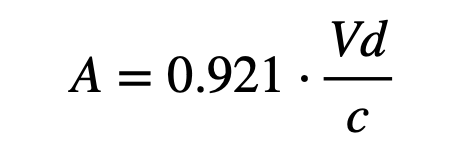
Where:
A = sound absorption, m²
V = volume of reverberation room, m³
c = speed of sound, m/s
d = decay rate, dB/s
As shown in the formula, the decay rate (otherwise reverberation time) is a requirement.
Since the variable c, speed of the sound, changes with temperature, it needs to be calculated based on the following equation at the time the test is performed:

Where: t = room temperature, °C
Consequently, to comply with the ASTM E336, ASTM E1007, ASTM E90, and ASTM E492 standards, it is necessary to calculate the room absorption characteristics and corresponding reverberation times. As a result, temperature input is also required as part of the measurement and calculation process.
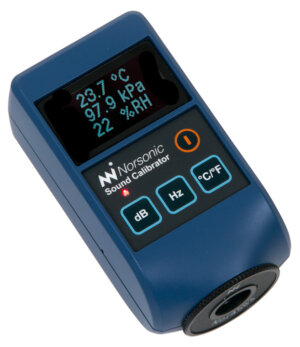
Fortunately, Norsonic’s Nor140, Nor145, and Nor150 analyzers account for these factors when performing the required measurements and calculations. Since an acoustic calibrator is an essential tool in any sound level meter toolbox, the Norsonic Nor1256 Multi-Frequency Acoustic Calibrator is an excellent choice, particularly because it can also measure environmental conditions such as barometric pressure, humidity, and temperature, the latter being required for calculating room absorption following reverberation time measurements.